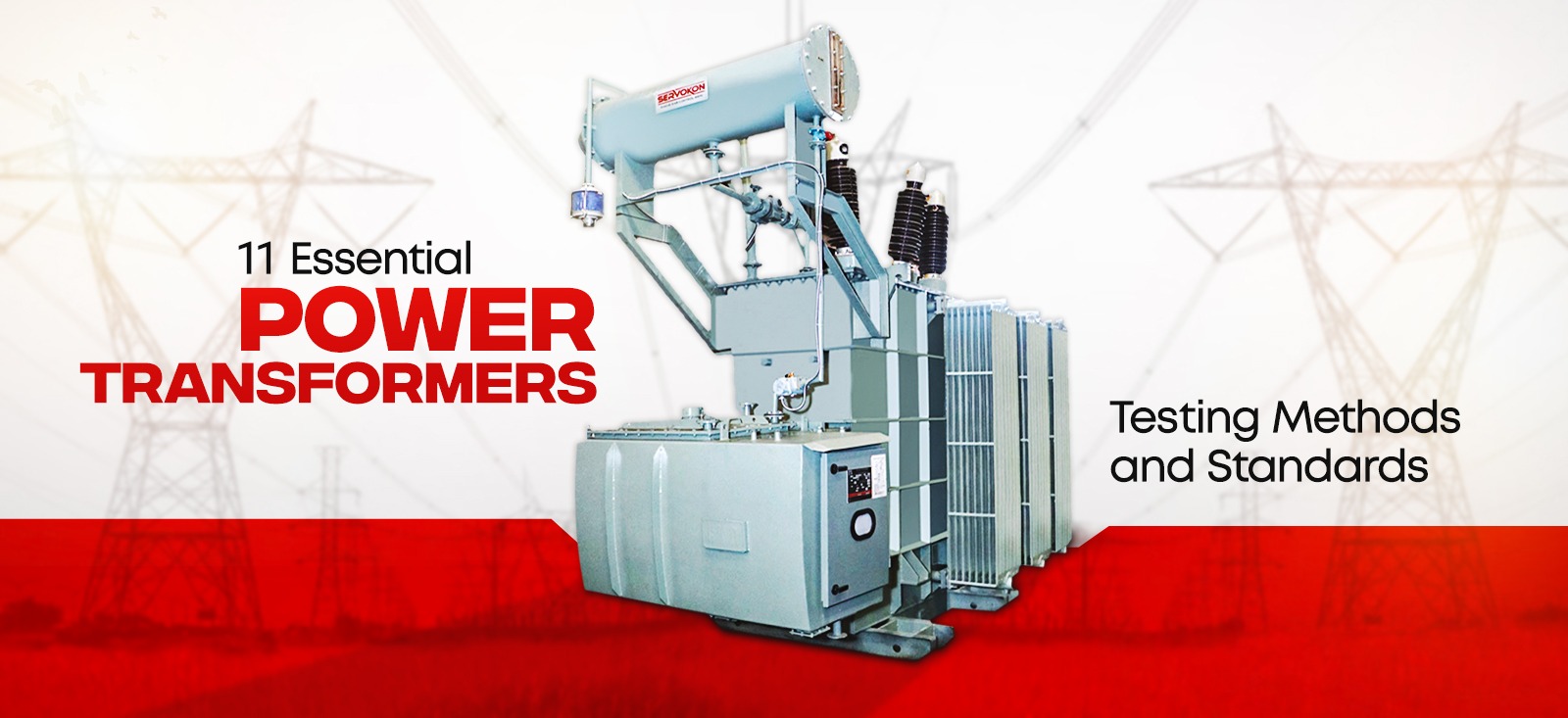
Whether it is the conventional power generation plant or the renewable energy farms, the power transformers are crucial in every electrical power network. Their function is to step up the voltage so that the power transmission is feasible over long distances. It is a complex assembly of windings, insulation, terminals, bushings, relays and a temperature gauge. Each part should function well for the whole transformer to give reliable performance. Therefore, a series of tests based on international and national standards needs to be done on them.
Essential Power Transformer Tests
1. Turns Ratio Test
The turns ratio is the relationship between the primary winding and the secondary winding. In this test, the rated value is matched with the measured ratio. If there is a deviation between the values, it indicates an incorrect connection or shorted turns.
2. Winding Resistance Test
This test is done to measure the direct current resistance of each winding. Tracking resistance indicates the ageing of the winding. If there is uneven reading, engineers look for loose joints, poor soldering or damaged conductors.
3. Load Loss and Impedance Test
Load losses and impedance value are measured at rated current. These indicate the copper losses and stray load losses when current flows through windings and how the transformer will act during faults. Accurate impedance is essential especially when multiple transformers are running in parallel.
4. Vector Group Verification
Vector group is the connection method of each winding and the phase displacement. It is verified to ensure that the transformer is connected properly to the grid. The mismatch can lead to an unwanted shift in phase and wrong relay operation.
5. Oil Quality and Dissolved Gas Analysis
Transformer oil is known for its insulation and for dissipating heat from the windings. In an oil quality test, the dielectric strength, moisture content, and acidity are measured, while the dissolved gas analysis tests the gases generated by internal heating, arcing or insulation decomposition. It is done regularly to monitor the health of the transformer.
6. No Load Loss
No load losses are hysteresis and eddy current loss. Excess value of these losses is a sign of a problem with core material, lamination and mechanical stress in the core. In the test, teh rated voltage is applied and input power is measured.
7. Dielectric Tests
Dielectric strength is the main property of the insulation system. To perform this test, a high voltage is applied to the windings between phases and earth. These tests are vital for transformer safety as they check that insulation clearances, solid insulation, oil and internal arrangements can withstand expected operating stresses.
8. Partial Discharge Measurement
Partial discharge is the electrical activity happening in the weak insulation, which can lead to failure. Sensitive instruments identify the particle discharge during type testing and diagnostic investigations to check insulation quality.
9. Short Circuit Withstand Test
These tests are conducted to verify that the transformer to withstand the mechanical stress caused by electrical faults. This is a test that demands high engineering skill and is mostly performed on a power transformer.
10. Impulse Test
This test is a simulation of lightning surges and overvoltages. If any irregularity is detected, it signifies a weakness in insulation or voltage distribution in the winding. It is done to ensure the ability of the transformer to withstand severe external disturbances.
11. Insulation Resistance Test
It measures resistance between windings and earth. This test is performed during commissioning and repeated throughout the course of the transformer’s life because when insulation deteriorates, there is a high risk of transformer failure.
Conclusion
To check the performance of the power transformer under the given environmental conditions, electrical loads and mechanical forces, the above-mentioned tests are essentially done. It assures teh quality of the component, safety and long-term performance under IEC and relevant IS guidelines. If you want to know more about transformer testing and consult with a company for these tests, reach out to Servokon. Our comprehensive ability to manufacture and commission has made us a reliable expert on every aspect of transformers.