Transformers are classified into broad categories. They are categorized by how they step up or step down voltage levels, or based on the number of phases, industrial applications, and special purposes like an inverter duty transformer for a solar energy system. For many years, insulation and cooling of the transformer’s core have used oil. These transformers can be pole-mounted or pad-mounted. The innovation in material science and engineering has given us new options for using distribution transformers. We at Servokon specialize in making transformers of different types, voltage classes and load levels. In this blog, we are sharing how dry-type and pad-mounted transformers differ from each other.
Difference Between Dry Type and Pad-Mounted Transformer
Understanding the key differences between dry-type and pad-mounted transformers is crucial. While both are used for stepping down voltage for the distribution of power, they have different mechanisms and constructions. Here are the key differences between these two transformers:
Construction
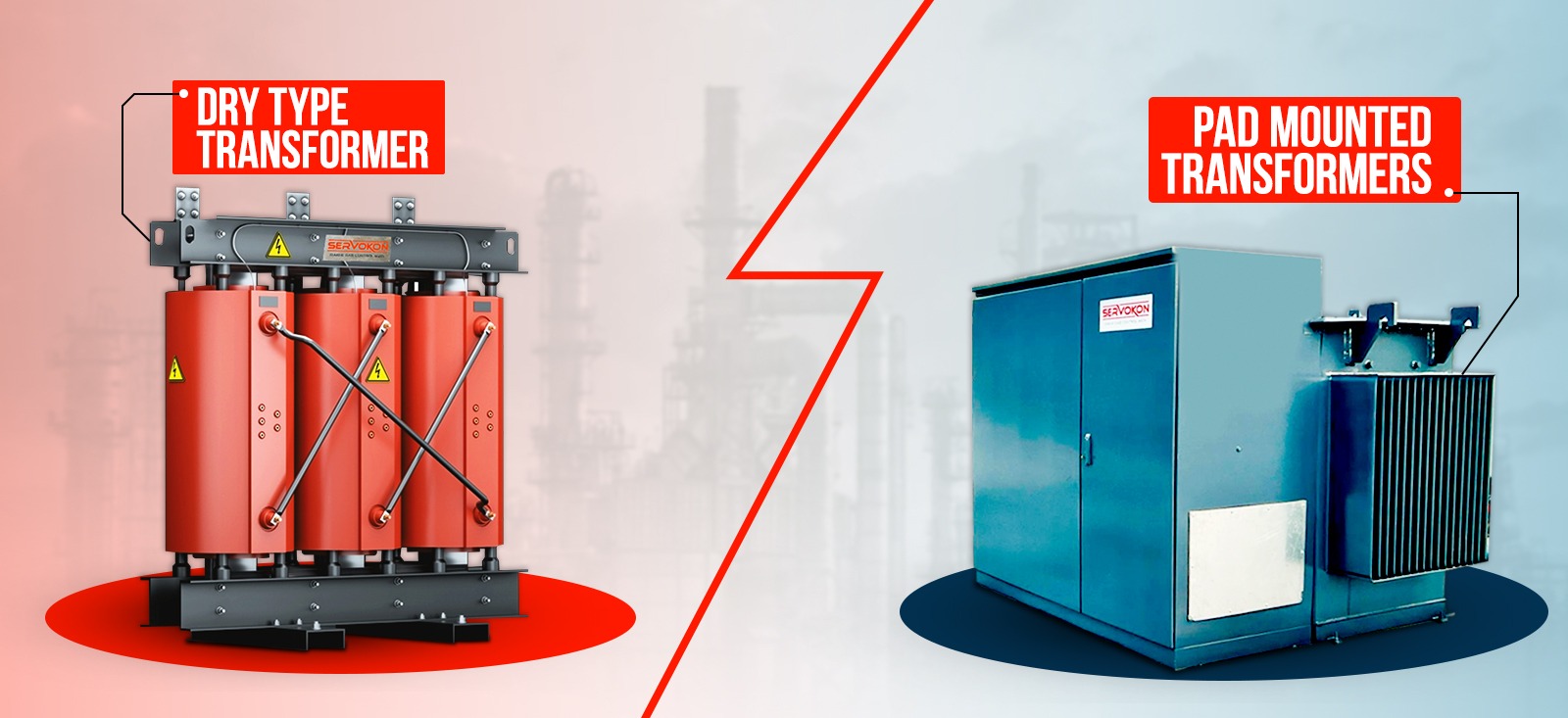
The insulating part in the dry-type transformer is made of epoxy resin and impregnated with moisture-resistant materials. Epoxy has a high dielectric strength and mechanical strength.
In the pad-mounted transformers, the core and windings are surrounded by the insulating oil. The tank is sealed with conservators and large fins for heat exchange. The whole assembly is locked inside a metal cabinet and mounted on the ground.
Cooling Mechanism
A dry-type transformer uses air for cooling. The small transformers can do with natural air, but the large ones depend on forced air circulation. It can also operate at high temperatures without catching fire because air has low thermal conductivity.
The pad-mounted transformer uses oil to cool down the heat coming from the windings. Warm oil rises and cooler oil sinks, which creates a circulation of thermal cycle for heat dissipation. Thus, it can operate at high load conditions.
Insulation Mechanism
The insulation in dry-type transformer is provided by cast resin and its finishing. Since it has a high dielectric constant, it prevents short circuits or moisture from penetrating the core.
Pad-mounted transformer contains mineral oil with high insulating properties. It creates insulation between windings and avoids electrical overarching. However, it needs to be checked regularly for contamination.
Suitable Application
Dry-type transformers are ideally chosen for areas with a risk of fire. Industries with sensitive machinery, schools, hospitals, basements and commercial buildings are the common applications.
On the other hand, pad-mounted transformers can handle low to medium voltage applications through the underground power distribution. Industrial zones, commercial complexes, metro rail systems, airports, IT parks, hospitals, and educational campuses are some of the prominent areas where these are used for power distribution.
Conclusion
Both pad-mounted and dry type transformers have their own set of advantages. The pad-mounted is used for underground power distribution, while the dry type is more useful for its fire safety properties. The innovation of cast resin as an insulating medium gave rise to the dry-type transformer, which is now popular in small zones where safety regulations are strict. By understanding these differences, one can choose the suitable transformer for their application. We at Servokon provide both of these types with high efficiency, durability and tailored to the specific needs of our clients.